The Last Input — Before the End
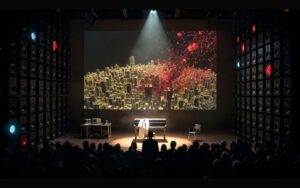
The Last Input is an immersive sound performance centered on the core theme of “letting go.” It explores a critical question: when artificial intelligence can generate everything, what meaning remains in the final input made by human hands? Set within a 49.4-channel spatial audio environment, the work constructs a digital ecosystem where two autonomously evolving AI species grow and collide.
The system operates two AI agents with distinct personalities and objectives: the “City,” which strives to maintain order, and the “Virus,” which continuously spreads, mutates, and attacks from within. Driven by language models, both agents possess memory, learning capabilities, and autonomous decision-making skills. During the live performance, they can evolve new strategies in response to each other’s behavior—making their choices entirely unpredictable, even to the artist.
Using a piano and a control interface, the artist inputs sounds and parameters for the City. These sounds are generated in real-time through an algorithmic audio system and spatialized across the 49.4 channels. The City’s sounds emanate from fixed directions, symbolizing the source of order, while the Virus’s sounds infiltrate from all sides, representing omnipresent decay.
The performance has no predetermined ending. Each show represents the singular, complete existence of this digital lifeform—an unrepeatable evolutionary process witnessed collectively by the audience, the artist, and the system itself.
Che-Yu Wu
Che-Yu Wu (b. 1995, Taipei) is a Taiwanese new media artist and founder of MonoLab, dedicated to casting eternal life and emotion in the digital world. Trained as an electrical engineer at National Yang Ming Chiao Tung University and in Integrated Digital Media at NYU, he combines engineering depth with algorithmic, interactive, and aesthetic practice to create digital works with their own voice and life force.
His works have been presented at the Venice Biennale (Soul Fish) and Art Basel Miami (The Soul of Flowers). In 2024, supported by TAICCA, he completed a residency at Centre Cent Quatre, Paris, producing The Eternal Garden in the Bottle. In 2025 he staged Algorithmic Verses, an immersive piano concert at Huashan 1914 Creative Park, Taipei. In 2026 his installation Unfinished Bloom was exhibited at the New Taipei City Museum of Art; the same year he launched Taiwan.md, an open-source knowledge initiative now read by over 92,000 people across more than 100 countries. His online courses on Hahow have reached over 23,000 students.
He lives and works in Taipei.
Tuning
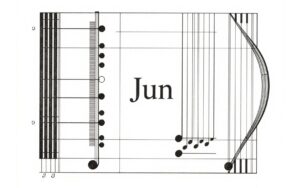
In ancient Chinese musicology, “Jun” (均) refers to the act of calibrating pitch—namely, “tuning.” This process of aligning sound with an accepted standard, along with the state it produces, is traditionally viewed as merely a preparatory stage rather than an independent sonic experience meant for listening.
Originating from an observation of this phenomenon, this project attempts to detach tuning from its functional purpose, transforming it into a perceptual experience centered on sound itself. By focusing on the “process of calibration,” the project explores how sounds gradually form relationships over time, aiming to construct a sonic space where listeners are invited to enter and linger.
Yng-Torng Kuo
A music and sound artist, Graduated from the Institute of Music at National Yang Ming Chiao Tung University, specializing in Electronic Music. Bridging a foundational root in classical music structure with rigorous academic training in electronic music, their current practice focuses on exploring the boundaries between contemporary electronic music and experimental sonic aesthetics. Through this interplay, they seek to sculpt a unique and recognizable sonic identity within the space between rational structures and emotional sound experiments.
Stone Dream v3.0
Stone Dream v3.0 is a kinetic sound installation. The space resonates with the reverberations of rocks and silicon wafers scraping and colliding. These subtle frictional sounds are expanded and extended to envelop the entire acoustic field, manifesting as the dream whispers of rock and silicon.
The work attempts to construct a recursive dialogue between materials, entangling them within the realms of ancient nature and contemporary technology. Has the processed silicon ever dreamed of its chaotic, primordial state? Or did the deeply deposited rocks, tens of millions of years ago, foresee their destiny as computational materials within a prophetic dream? The noise and reverberations born from the mutual interpretation and misinterpretation between these materials layer and materialize within a multi-channel soundscape, ultimately generating a dream that belongs entirely to the materials themselves.
Hsin-Yuan Ho
Born in 2001, Hsin-Yuan Ho is currently pursuing a Master’s degree at the Graduate Institute of New Media Art, TNUA. The work primarily focuses on sound installations, kinetic installations, and audiovisual. Ho explores the intricate relationships between systems, machinery, space, and humans, specifically focusing on the behavioral discrepancies of technical systems. By attempting to transform system failure and latency into an alternative operational logic, Ho seeks out interactive relationships between disparate objects through continuous experimentation, generating unique dynamics and soundscapes.