The field of medicine wields the power to define what counts as a healthy, complete, and “normal” body. This authority not only shapes clinical diagnoses and treatment standards but also profoundly informs society’s understanding and expectations of normality. Such disciplinary power often overlooks bodily diversity, treating experiences that deviate from established norms as abnormal or even pathological, thereby excluding bodies and lives that do not fit mainstream medical definitions.
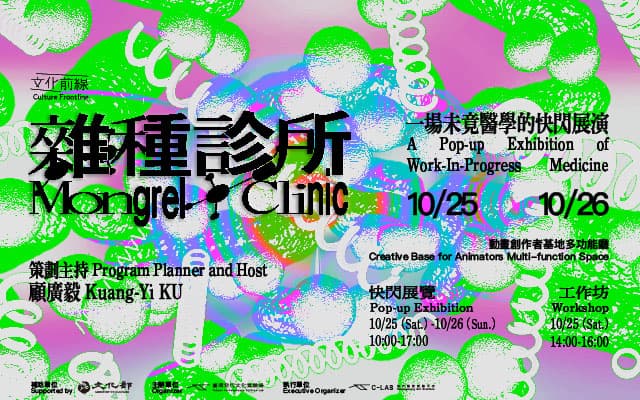
In Mongrel Clinic, a two-day event, we seek to unsettle the boundaries of mainstream medicine and challenge the conventions of the body. This temporary experimental space brings together artists, designers, medical practitioners, and others, many with hybrid or multiple identities, to imagine how plural narratives of medicine can be created and how the formal order of health might be blurred.
The word “mongrel” implies mixture, impurity, and mismatch. In human society, it has even become an insult, yet in biological evolution, mongrels often embody new potentials for adapting to sudden environmental changes. Carrying both the weight of stigma and the promise of resilience, Mongrel Clinic operates as a cross-disciplinary knowledge experiment. It moves between the orthodox and the impure, exploring diverse situations of healing and cure through speculative medical technologies, flipped disease narratives, and the queering of the body.
Over its two days, the event unfolds through a workshop and a pop-up exhibition. Visitors and participants are invited not merely to step into a clinic, but to enter a space of unfinished healing, disciplinary dislocation, and the reassembling of bodies and futures.
活動日期:10/25週六至10/26週日
〔快閃展覽〕10/25週六至10/26週日 10:00-17:00
〔工作坊〕10/25週六14:00-16:00
地點:臺灣當代文化實驗場C-LAB動畫創作者基地多功能廳
〔快閃展覽〕參展作品列表:
酷兒解剖學圖譜(2025),顧廣毅
Atlas of Queer Anatomy (2025), Kuang-Yi Ku
https://www.kukuangyi.com/atlas-of-queer-anatomy.html
《酷兒解剖學圖譜》計畫的目標是通過構建一個模糊、曖昧、不確定、波動的解剖學系統,挑戰醫學父權和解剖學教育中的異性戀正常性。新教科書《酷兒解剖學圖譜》的出版,這是對經典解剖學教科書《人體解剖學圖譜》(由白人男性學者Frank H. Netter(1906-1991)繪製)的諷刺與反思。《人體解剖學圖譜》首次出版於20世紀中期,一直廣泛用於醫學教育至今。儘管它是一本經典教科書,但它在解剖視覺化這方面高度缺乏包容性與多樣性。例如該書中的器官與身體大多都是白人異性戀男性的身體為主,缺乏其他性別與人種的視覺詮釋。因此,新的《酷兒解剖學圖譜》將是一系列強調性別多樣性的解剖圖像,藉此去批判《人體解剖學圖譜》的局限性。
The Atlas of Queer Anatomy project aims to construct an anatomical system that is blurred, ambiguous, indeterminate, and fluid, challenging both medical patriarchy and the heteronormativity embedded in anatomical education. The forthcoming textbook Atlas of Queer Anatomy is conceived as an ironic and critical response to the canonical Atlas of Human Anatomy illustrated by white male scholar Frank H. Netter (1906–1991). First published in the mid-20th century and still widely used in medical education today, Netter’s atlas is regarded as a classic. However, it lacks inclusivity and diversity in its anatomical visualizations: organs and bodies are overwhelmingly represented through the lens of white, heterosexual male bodies, leaving little space for other genders and ethnicities. In contrast, the new Atlas of Queer Anatomy will present a series of anatomical illustrations that foreground gender diversity, thereby directly critiquing the limitations of the traditional Atlas of Human Anatomy.
–
顧廣毅(Kuang-Yi Ku)
http://www.kukuangyi.com/
顧廣毅居住於荷蘭與台灣從事創作工作,目前為國立陽明交通大學應用藝術研究所專任助理教授,並任教於荷蘭恩荷芬設計學院(Design Academy Eindhoven)社會設計研究所(MA, Social Design)。他同時於英國雪菲爾哈倫大學進行藝術設計與生物科學的跨領域創作博士研究。碩士畢業於荷蘭恩荷芬設計學院(Design Academy Eindhoven)社會設計研究所(MA, Social Design)、國立陽明交通大學臨床牙醫學研究所、實踐大學媒體傳達設計研究所,大學畢業於高雄醫學大學牙醫學系;具有牙醫師、生物藝術家以及推測設計師等多重身分。他試圖拓展藝術、設計與科學結合的可能性,作品主要專注於臨床醫學、人類身體、人與其他物種的關係以及性別議題,嘗試藉由藝術實踐與設計方法去探索科學領域中的倫理問題,並藉此思考科技、人類個體和環境之間的關係。
他的作品曾獲多個國內外奬項,例如:奧地利林茲電子藝術獎(Prix Ars Electronica)榮譽獎(Honorary Mention)、生物藝術與設計大獎(Bio Art& Design Award)首獎、臺北數位藝術獎首獎、臺北美術獎入選、美國Core77 Design Awards的Speculative Design Award專業組首獎、荷蘭恩荷芬設計學院Gijs Bakker Award首獎、荷蘭未來食物設計大獎 Future Food Design Award前三名。此外,他的作品更受邀參與國際重要展覽,如德國柏林Transmediale跨媒體藝術節、奧地利林茲電子藝術節、荷蘭設計周、米蘭設計周、比利時根特設計博物館、英國倫敦V&A博物館等等。而他的作品曾刊登於多份國際媒體,包括New Scientist、The Huffington Post、Elephant Magazine、DAMN°、Dezeen、Designboom、VICE、Dazed Digital、Daily Mail、New York Post等。
Kuang-Yi Ku lives and works between the Netherlands and Taiwan. He is an Assistant Professor at the Institute of Applied Arts, National Yang Ming Chiao Tung University (Taiwan), and teaches in the Social Design master’s programme (MA, Social Design) at Design Academy Eindhoven (the Netherlands). At the same time, he is pursuing a practice-based PhD at Sheffield Hallam University (UK). Ku earned three master’s degrees: an MA in Social Design from Design Academy Eindhoven; an MSc of Dentistry at National Yang Ming Chiao Tung University; and an MA of Communication Design at Shih Chien University. He also holds a Doctor of Dental Surgery (D.D.S.) from Kaohsiung Medical University. Combining the identities of dentist, bio-artist, and speculative designer, Ku explores new possibilities for integrating art, design, and science. His works focus on clinical medicine, the human body, interspecies relationships, and gender issues, using artistic practice and design methods to question ethical problems in science and to reconsider the relationships among technology, individuals, and the environment.
Ku’s projects have received numerous national and international accolades, including an Honorary Mention at the Prix Ars Electronica (Austria), the Bio Art & Design Award (Netherlands), First Prize at the Taipei Digital Art Awards, selection for the Taipei Fine Arts Awards, the Speculative Design Professional Winner at the Core77 Design Awards (USA), the Gijs Bakker Award (Netherlands), and Top Three at the Future Food Design Award (Netherlands). His works have been presented at major international exhibitions and festivals such as Transmediale (Berlin), Ars Electronica Festival (Linz), Dutch Design Week, Milan Design Week, Design Museum Ghent (Belgium), and the Victoria and Albert Museum (London). They have been widely featured in international media including New Scientist, The Huffington Post, Elephant Magazine, DAMN°, Dezeen, Designboom, VICE, Dazed Digital, Daily Mail, and New York Post.
我們自己的受汙花園(2024),蘇珊娜.克拉維亞里
A Contaminated Garden of Our Own (2024), Suzanne Craviari
https://suzannecraviari.com/a-contaminated-garden-of-our-own-1
《我們自己的受汙花園》是一場在受汙染土地上集體播種藥草的行動。這次聚會重新詮釋了草藥療法的歷史與性別化實踐,在後自然的景觀中散播療方與毒素。由於人類身體並非對工業過去的遺緒無動於衷,土地中的污染物能進入體內並影響荷爾蒙系統。若人們飲用的鼠尾草茶(通常被認為有助於女性荷爾蒙調節)受到污染,它便成為一種複雜的存在,同時具備療方與毒性的雙重特質。這個計畫從生態女性主義的視角探討這種曖昧性,佔據被工業所烙印的土地,播下能夠協助面對荷爾蒙失調的女性盟友植物種子。透過園藝與知識復興,而非收成,該計畫將受汙染的土地轉化為修復之地。
A Contaminated Garden of Our Own is a collective sowing of medicinal herbs on contaminated land. The gathering recontextualises herbalism’s historical and gendered practice, spreading remedies and poisons in a post-natural landscape. Since human bodies are not inert in the face of the industrial past, contaminants in landscape can enter the body and affect hormonal systems. If the sage tea that one drinks, known for supporting women’s hormones, is contaminated, it becomes a complex entity – both remedy and poison. The project explores this ambiguity from an ecofeminist perspective, occupying lands marked by industry and sowing seeds that are allies for women facing hormonal disorders. It transforms contaminated land into a place of repair through gardening and knowledge revival instead of harvesting.
–
蘇珊娜.克拉維亞里(Suzanne Craviari)
https://suzannecraviari.com/
蘇珊娜.克拉維亞里(Suzanne Craviari)是一位常駐比利時布魯塞爾的法國設計師,關注社會生態議題,特別著重於將傳統工藝與知識與當代生態學對話的可能性。她以研究為核心的創作實踐涵蓋多媒體敘事、現地提案、資訊分享與行動。她擁有荷蘭恩荷芬設計學院(Design Academy Eindhoven)社會設計碩士學位、瑞士日內瓦藝術與設計高等學院(High School of Art and Design of Geneva)產品設計學士學位,以及法國巴黎布勒學院(École Boulle)工藝珠寶師文憑。
Suzanne Craviari is a French designer based in Brussels (BE) who focuses on social ecology; particularly on traditional crafts and knowledge in dialogue with contemporary ecology. Her research-based practice involves multimedia storytelling and on-site proposals, information sharing and action. She holds a MA in Social Design from the Design Academy Eindhoven (NL), a BA in Product Design from the High School of Art and Design of Geneva (CH) and an artisan jeweller’s diploma from École Boulle in Paris (FR).
痘痘勞動(2024),艾瑪.蘭巴-邦德
Acne Labour (2024), Emma Lambaa-Bonde
https://acnelabour.netlify.app/#top
成人痘影響約 20% 的女性,常造成強烈的負面自我認知與社交焦慮。許多女性為了追求「乾淨的臉」投入大量時間、金錢與精神能量。《痘痘勞動》重新思考「保養」這一看似放鬆的休閒活動,從女性主義勞動理論的視角指出:那些在家中重複且無酬的保養步驟,其實也是一種勞動。
這件沉浸式裝置作品的現場設計成一間被扭曲變形的浴室。影像中,女性在鏡前進行日常護膚程序,而她們皮膚下隱藏且混亂的勞動過程也隨之顯現。YouTuber 的聲音與粉刺擠壓工具的機械聲交織成富有節奏的聲響景觀,揭露這些看似日常的動作背後的勞動性。
作品根植於數位民族誌與醫學現象學的研究方法,試圖在生物醫學對成人痘的理解之外,納入情感、社會與女性主義的多重面向。
Adult acne affects 20% of women, often leading to severe negative self-perception and social anxiety. These women invest a significant amount of time, money, and mental energy in the pursuit of a ‘clean face’. Acne Labour rethinks “skincare” as a supposedly relaxing leisure activity. Through the lens of feminist labour theory, this installation highlights that the unpaid, repetitive tasks performed in the home are, in fact, forms of labour.
Acne Labour is an immersive installation set in a distorted bathroom. A video depicts women going through their daily routines in front of the mirror. As they apply products, the hidden and chaotic labour processes beneath their skin are uncovered. Voices of YouTubers and the mechanical sounds of acne tools are woven into a rhythmic soundscape.
Rooted in digital ethnography and medical phenomenology, Acne Labour seeks to expand the biomedical understanding of this health condition by including its emotional, social, and feminist dimensions.
–
艾瑪.蘭巴-邦德(Emma Lambaa-Bonde)
艾瑪.蘭巴-邦德(Emma Lambaa-Bonde,she/her,1994 年生)同時具備生物化學家、藥學工程師與社會設計師的身份。她的研究關注健康狀況所引發的情緒副作用、行為改變與文化再現,其創作反思藥物與醫療系統如何在「控制」與「照護」之間拉扯,並探索如何透過社群與視覺文化的設計來消除污名化。
Emma Lambaa-Bonde (she/her, 1994) is a biochemist, pharmaceutical engineer and social designer, researching the emotional side effects, behavioral changes and cultural representations of health conditions. Her practice reflects on how pharmaceuticals and medical systems offer control versus care, and how destigmatisation can occur through the design of community and visual culture.
來自《魔山療養院》的一些田野紀錄(2025),許彤
Some Fieldnotes from The Magic Mountain Sanatorium (2025), Hsu Tung
《魔山療養院》是一部我以虛構療養院為場景的文學創作,而此次展覽〈來自《魔山療養院》的一些田野紀錄〉,則嘗試將小說中的身體觀以裝置藝術形式具體化,其核心在於對身體觀的再思考。作品延續田野筆記的書寫方式,將醫療實踐中最細微的診察動作,轉化為一種關於身體的敘事。這些紀錄並非單純的醫療描寫,而是試圖揭示病患、醫者與照護者如何共同形塑一種「在地化」的醫療知識,藉由這些記錄,我希望觀者能一同經歷那種徘徊於懷疑與信任之間的感受,並思考疾病、療癒與生命信仰的多重語言。
在療養院中,身體被視為一個多重語境交織的場域。它既承載著疼痛、症狀與未解的病因,也同時是一種文化符號與社會實踐的結晶。疾病經驗不只限於生物醫學的範疇,而是透過語言、儀式、信任與不確定性交織而成。這些田野紀錄因此不僅反映個人的身體經驗,也折射出集體的醫療信仰。
The Magic Mountain Sanatorium is a literary work I created, set in a fictional sanatorium. This exhibition, Some Fieldnotes from The Magic Mountain Sanatorium, attempts to materialize the novel’s conception of the body through installation art, centering on a rethinking of bodily perspectives. The work adopts the form of fieldnotes, transforming the smallest gestures of medical examination into narratives about the body. These records are not merely medical descriptions; rather, they seek to reveal how patients, physicians, and caregivers collectively shape a form of localized medical knowledge. Through these notes, I hope the audience can experience the lingering tension between doubt and trust, and reflect on the multiple languages of illness, healing, and faith in life.
Within the sanatorium, the body is regarded as a field where multiple contexts intersect. It bears pain, symptoms, and unresolved causes, while also serving as a cultural symbol and the crystallization of social practice. The experience of illness extends beyond the biomedical domain, formed instead through the interplay of language, ritual, trust, and uncertainty. These fieldnotes therefore not only reflect individual bodily experiences but also refract collective medical beliefs.
–
許彤(Hsu Tung)
許彤,新竹人,目前身分為研究生以及中醫診所助理。
自我定位為擁有藝術家與人類學家靈魂的創作兼研究者,擅長使用物件與影像塑造場景,引領觀者進入作品敍事當中。個人作品陸續在鳳甲美術館(2024)、新竹241藝術空間(2025-2026)展出,目前也正進行醫療文學創作的個人實踐。
Hsu Tung, from Hsinchu, is currently a graduate student and a clinical assistant at a Chinese medicine clinic. Positioning herself as both an artist and an anthropologically minded researcher, she works with objects and images to construct immersive scenes that draw audiences into the narrative of her works. Her projects have been exhibited at Hong-Gah Museum (2024) and Hsinchu 241 Art Space (2025–2026). She is also pursuing an ongoing personal practice in medical literature and creative writing.
性・體液重構計劃 (2024)
Fluid Boundaries Reconstruction Center (2024)
藝術家:桂語謙
視覺與裝置設計:高永翰
資料研究:張心嘉
https://www.elizguei.com/fluidboundariesreconstructioncenter
本作以推測設計為方法,虛構一項將男性尿道球腺功能移植至腸道的手術,使個體在性興奮、肛交時能分泌潤滑液。以超越自然設定的生理重構,挑戰醫療僅為治療的想像,並轉化為創造性的身體設計。藉由重編腸道菌群與分泌系統,揭示身體如動態生態系的可塑性。展場結合手術廣告、醫療器材與聲音檔案,營造多感官情境,迫視倫理與慾望的邊界,提出身體能否被重新設計的思辨。
This work employs speculative design to imagine a surgical procedure that relocates the function of the male bulbourethral gland to the intestine, enabling the body to secrete lubricant during sexual arousal and anal intercourse. Through a physiological reconfiguration that transcends natural settings, it challenges the notion of medicine as solely therapeutic and repositions it as a creative act of bodily design. By reprogramming the gut microbiome and secretion systems, the work reveals the body’s plasticity as a dynamic ecosystem. The exhibition integrates surgical advertisements, medical instruments, and sound recordings to construct a multisensory environment, confronting the boundaries of ethics and desire while raising the question: can the body itself be redesigned?
–
桂語謙(Kuei Yu Chien)
https://www.elizguei.com/
桂語謙,跨領域創作者,擅長解構當代數位文化符號,運用幽默而批判的視覺語言,捕捉世代情感脈動、文化諷刺與社會議題。現專注於推測設計與生物藝術領域,將自身身體作為實驗性創作場域,深入探索藝術與科技間的動態交互關係,創造引發思考的感官共鳴。
Kuei Yu Chien (Eliz Guei) is an interdisciplinary creator whose practice deconstructs contemporary digital cultural symbols. Through a humorous yet critical visual language, their work captures generational emotions, cultural irony, and pressing social issues. Currently focusing on speculative design and bio-art, Gui employs the body as an experimental site of creation, delving into the dynamic interplay between art and technology to evoke sensory resonance and provoke reflection.
赭色顯影:身體存檔與流動邊界(2025),張宇蕎
Ochre Development: Body Archiving and Fluid Boundaries (2025), Yu-Chiao Chang
https://fagopyrum.framer.website/works-unconscious-body-ochre-development-body-archiving-and-fluid-boundaries
本系列作品延續了藝術家持續進行的經血顯影計劃,將身體最私密且長期被污名化的流體引入攝影史,作為挑戰影像存檔與觀看機制的實驗。此項技術是以十九世紀的蛋白印相術為出發點,一項曾消耗數以百萬計之雞蛋、在攝影工業中將母雞生殖物質轉化為標準化資源的歷史技法作為背景脈絡,並以經血部分取代蛋白構築替代存檔系統,將身體記憶可視化,透過影像媒介存檔。經血與蛋既皆是身體變化的具象物,也更是污名與壓迫的記憶承載體,不僅挑戰影像技術的中立性假象,也揭露觀看機制中對陰性身體的排除與規範。
This work continues the artist’s project of menstrual blood imaging, adapting the nineteenth-century albumen print that once consumed millions of eggs. By replacing egg white with menstrual blood, it creates an alternative archive that visualizes bodily memory. Both substances embody change yet carry stigma, exposing how reproductive materials are regulated and erased, while questioning photography’s neutrality and the exclusion of certain bodies from the archive.
–
張宇蕎(Yu-Chiao Chang)
https://fagopyrum.framer.website/
張宇蕎,生於臺灣臺中,目前於國立陽明交通大學應用藝術研究所攻讀碩士學位,先前於高雄醫學大學牙醫學系取得學士學位,擁有牙醫師專業背景。主要關注人類身體、意識認知與賤斥狀態,探討個體存在的本真性、社會與科技發展的趨勢。同時亦嘗試從自然科學視角切入藝術實踐,探索兩者之間的交集與對話。透過實驗性的複合媒材與跨領域方法,探討身體如何在科技、社會規範與個人經驗的交織下被理解與再現。曾獲法藍瓷光點計畫獎學金補助 (2023)、入選桃源美展 (2023)。
Yu-Chiao Chang (Fagopyrum C.) is a dentist and artist currently pursuing a master’s degree at the Institute of Applied Arts, National Yang Ming Chiao Tung University. With a background in dentistry from Kaohsiung Medical University, their practice focuses on the body, consciousness, and states of abjection, examining how technology, social norms, and personal experience shape our understanding of existence. Combining natural science perspectives with experimental, cross-disciplinary methods, they seeks new dialogues between science and art. They was awarded the Franz Rising Star Scholarship (2023) and nominated for the Taoyuan Fine Art Exhibition (2023).