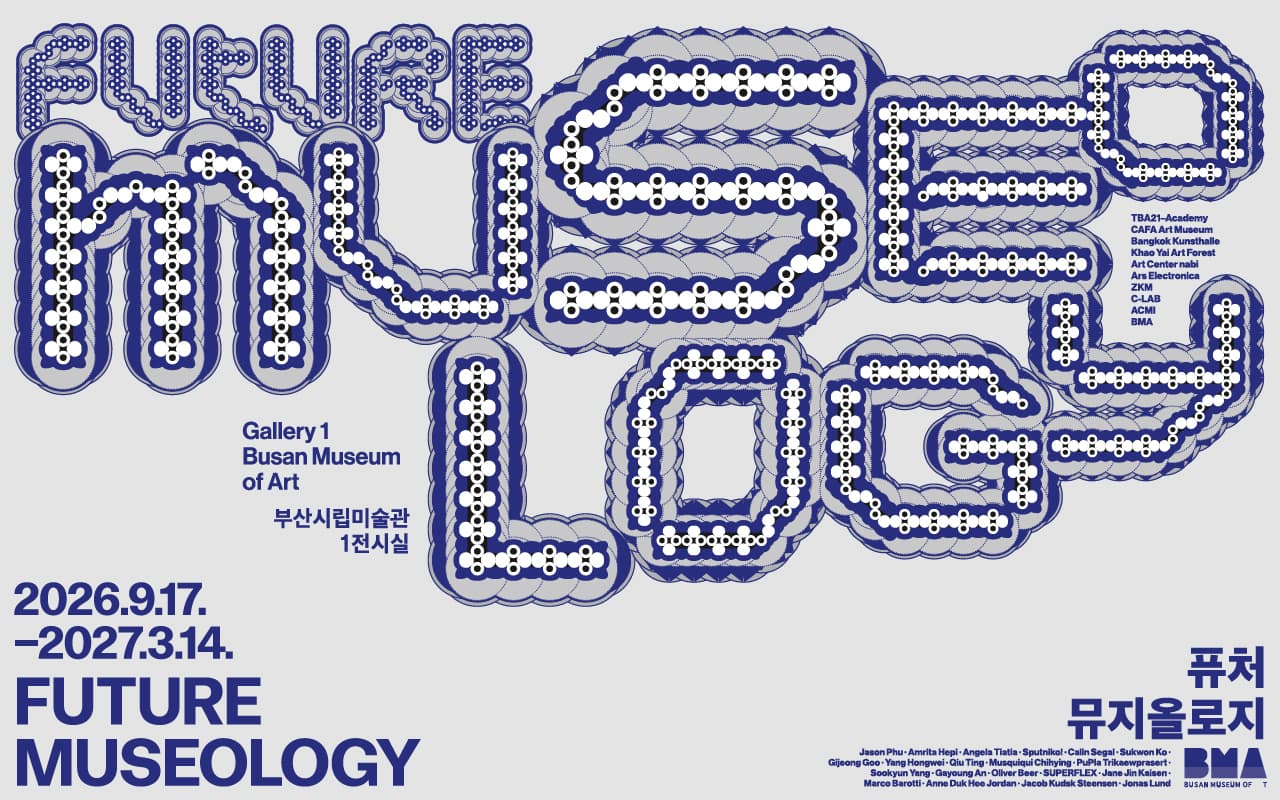
Taiwan Contemporary Culture Lab (C-LAB) has been invited to participate in Future Museology, a major exhibition marking the reopening of the Busan Museum of Art in South Korea. The exhibition runs from September 17, 2026 to March 14, 2027, and is presented in the Grand Exhibition Hall of the Busan Museum of Art.
C-LAB’s participation, titled Afrasian Neural Network, is co-curated by Wu Dar-Kuen, Director of the Contemporary Art Experimental Platform, and curator Huang Yi-Hsuan, with the participation of Taiwanese artist Musquiqui Chihying.
Presenting Taiwanese artist Musquiqui Chihying’s recent research practice, the exhibition traces a genealogy from the nineteenth-century Asian coolie trade, examining how labour and infrastructure became intertwined across the Afrasian maritime world. Focusing on cities and island territories that once served as transit hubs within the coolie system, it explores how these sites evolved from early experiments linking visual technologies and labour regimes into contemporary nodes of smart city development and global submarine cable networks.
Submarine cables, submerged beneath the ocean yet carrying more than ninety per cent of global data traffic, constitute a “planetary neural network” sustaining contemporary communication and geopolitical operations. Control over these infrastructures entails control over the circulation of information. Therefore, critical engagement with contemporary smart cities must also consider the cartographies of submarine cable networks and the interdependence between geographic and informational nodes.
Deeply embedded within submarine cable networks and semiconductor infrastructures, Taiwan is not only a node connecting global networks, but also a geopolitical fault line where security, governance, and technological imagination are continuously negotiated. It reveals how historical labour regimes, technological development, and geopolitical tensions converge in the present while projecting themselves into uncertain futures.
Situated within a broader Afrasian and oceanic framework, the exhibition approaches the museum as a “neural network”—a system composed of perceptual nodes connecting different regions, temporalities, and political scales, while reexamining the evolving relationships between humans, images, labour, and technology.
Participating institutions include ACMI, Ars Electronica, Art Center nabi, CAFA Art Museum, Khao Yai Art Forest, Bangkok Kunsthalle, TBA21, ZKM, and the Busan Museum of Art, among others. Through contemporary art, each institution presents its own vision of what the museum of the future might become.