When we choose to engage with a particular segment of the geopolitical world, does such a choice constraint or instead expand the assumptions embedded in the notion of “WE”? During the air raids in the Pacific War, LI Shih-Chiao published his wartime situation painting Chorus in the tenth Tai-Yang Fine Arts Exhibition. The colonial government encouraged artists to “serve the nation with paint” under wartime mobilization, making wartime situation painting a common subject in the wartime fine art exhibitions. Since it’s a painting, the chanting implied in Chorus eternally stays in the state of readiness, supposed to give voice, but yet to do so.
The 2026 annual exhibition at the Taiwan Contemporary Culture Lab, WE are Becoming, features a forum entitled “Chorus as Method.” Mobilizing the conceptual resonances of “chorus”—including resonance, and the sedimentation of collective memory—the forum adopts a transregional framework to interrogate arts in wartime. It is organized into two sessions: the morning panel, “Afterlife of Art in Wartime: Stories in Japan and Taiwan,” and the afternoon panel, “Re-sounding: the Friction between the Audible and the Visible.” By situating artistic practices within both (post-)war contexts and contemporary conditions of existence, the forum seeks to critically rearticulate and reconstitute the very terms through which “WE” is imagined and constituted.
Time: 05/30 (Sat.) 10:00-17:30
Venue: R102 Coworking Space
*Consecutive Interpretation in Mandarin, Korean, and Japanese Provided.
▶ Free Admission via Online Registration
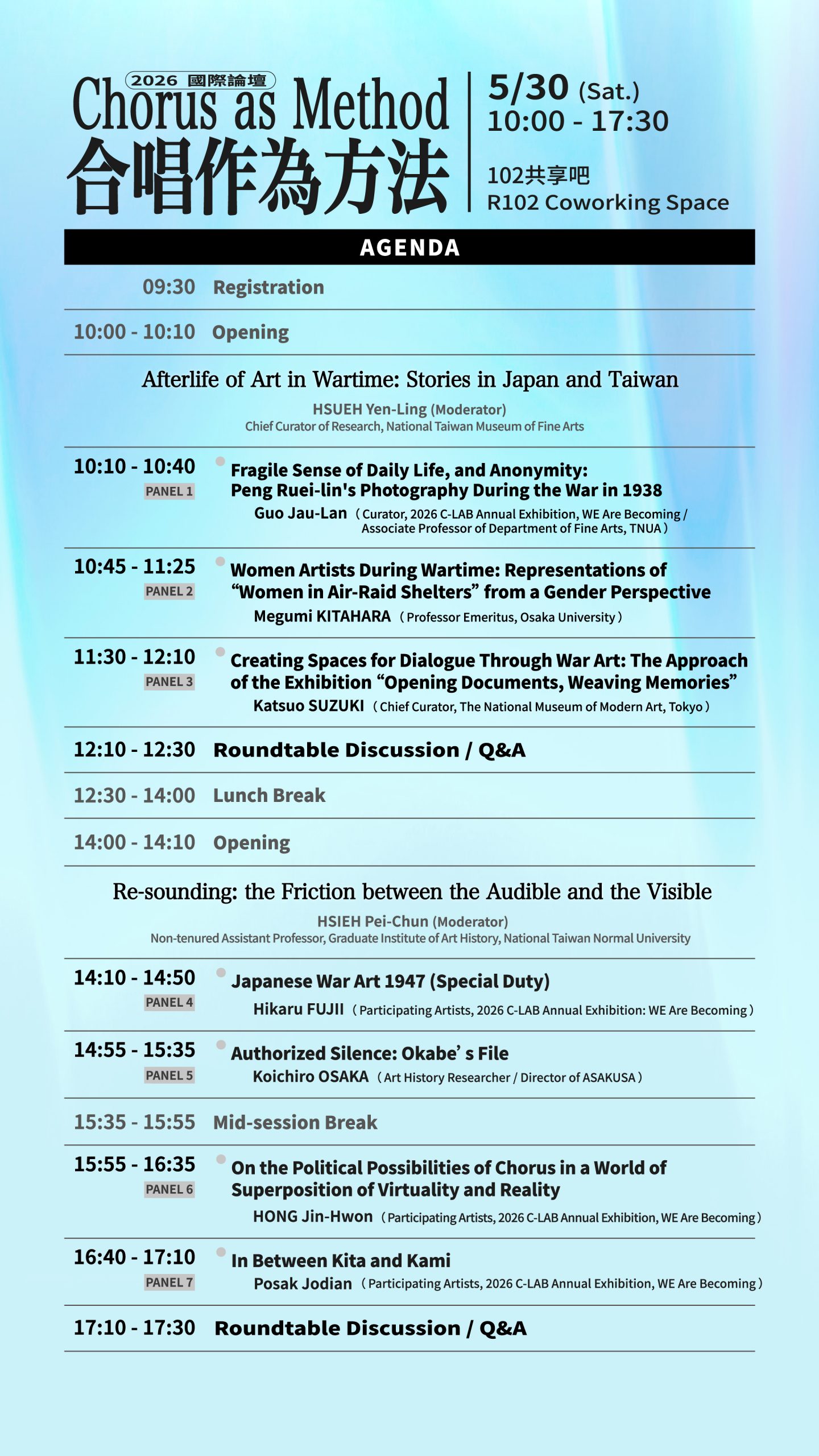
FIRST SESSION|Afterlife of Art in Wartime: Stories in Japan and Taiwan
Moderator: HSUEH Yen-Ling
Eighty years after the end of World War II, “Afterlife of Art in Wartime: Stories in Japan and Taiwan” focuses on artworks created during wartime. LI Shih-Chiao’s Chorus and the wartime works of PENG Ruei-Lin were not officially commissioned “war paintings,” yet, like Japanese war paintings, they were marginalized and erased from public memory due to the paradigm shifts brought about by post-war political changes.
The forum opens with a lecture titled, Fragile Sense of Daily Life, and Anonymity: Peng Ruei-lin's Photography During the War in 1938 by GUO Jau-Lan, and also features Professor Megumi KITAHARA, Professor Emerita at Osaka University and a specialist in Japanese war paintings and women’s studies, as well as Katsuo SUZUKI, curator of Opening Documents, Weaving Memories at the National Museum of Modern Art, Tokyo. Their presentations examine the post-war “reception history” and “exhibition history” of Japanese war paintings, together with the perspectives of gender studies reflected through these narratives. By placing LI Shih-Chiao’s Chorus in dialogue with these contemporaneous works and histories, the forum seeks to reconstruct the multiple trajectories experienced by wartime artworks in the aftermath of war.
PANEL INFO
▍PANEL 1
Fragile Sense of Daily Life, and Anonymity: Peng Ruei-lin's Photography During the War in 1938
Speaker: Guo Jau-Lan
▍PANEL 2
Women Artists During Wartime: Representations of “Women in Air-Raid Shelters” from a Gender Perspective
Speaker: Megumi KITAHARA
▍PANEL 3
Creating Spaces for Dialogue Through War Art: The Approach of the Exhibition “Opening Documents, Weaving Memories”
Speaker: Katsuo SUZUKI
SECOND SESSION|Re-sounding: the Friction between the Audible and the Visible
Moderator: HSIEH Pei-Chun
Sound has always been associated with departure and disappearance. Re-sounding: the Friction between the Audible and the Visible approaches LI Shih-Chiao’s Chorus as “a recording tape waiting to be played in unison,” or “an event score left behind by those before us.” To restage this work is to allow voices that were forced into silence amid historical upheavals to be heard once more; it is also a vocal exercise long delayed until the present.
The forum invites Tokyo University of the Arts professor and contemporary artist Hikaru FUJII, independent curator Koichiro OSAKA, Korean artist HONG Jin-Hwon, and Amis artist Posak Jodian to respond, through their artistic practices, to questions of history and life embedded in their work.
In this sense, the synchronicity and contrapuntal relationships implied by the idea of “chorus” open up new perspectives on LI Shih-Chiao’s painting of its historical moment. Grounded in the collective support of shared voices, Chorus becomes a point of departure for imagining and producing a sense of “WE.”
PANEL INFO
▍PANEL 4
Japanese War Art 1947 (Special Duty)
Speaker: Hikaru FUJII
▍PANEL 5
Authorized Silence: Okabe’s File
Speaker: Koichiro OSAKA
▍PANEL 6
On the Political Possibilities of Chorus in a World of Superposition of Virtuality and Reality
Speaker: HONG Jin-Hwon
▍PANEL 7
In Between Kita and Kami
Speaker: Posak Jodian
MODERATOR INFO
▍HSUEH Yen-Ling
Chief Curator of the Research Department, National Taiwan Museum of Fine Arts
HSUEH Yen-Ling holds a Master’s degree in Arts from the Graduate School of Arts, College of Art, Nihon University, Japan. Her research interests include modern and contemporary Taiwanese art history, museum collection and conservation management, and museum collection policies. She previously served as Head of the Collection Department at the National Taiwan Museum of Fine Arts and is currently Head of the Research Department at the same institution. In recent years, she has curated or co-curated major exhibitions such as Rhythmic Beauty in the Interplay of Colors: Liao Chi-chun’s World of Art (2026), Arts as Imprints of the Times: Permanent Collection of the NTMoFA (2024-2025, co-curator), An Undefeatable Quest for Freedom and Beauty: The Life and Art of Huang Tu-shui (2023), Reality through the Paintbrush– Art Exhibition in Commemoration of Li Mei-shu's Shu’s120th Posthumous Birthday (2022), and Flowers of Immense Charm: A Masterpiece Exhibition by Four Major Museums (2018, co-curator). Her research publications include “Symphonic Resonance with Light as Guidance and Color as Pathway—The Art of Liao Chi-chun” (2026), “Revealing the Distinctiveness—The Local Flavor of Taiwanese Art in the Early 20th Century” (2025), “The Radiance of Modern Taiwanese Sculpture—Revisiting Huang Tu-shui’s Era and Artistic Life” (2023), “Reality through the Paintbrush: The Local Aesthetics of Li Mei-shu’s Nativist Gaze ” (2022), “An Analysis of the Relationship between Dr. Hsu Hong-yen’s Sun Ten Collection and the Development (1970s-1980s)” (2020), “The Carpet of Flowers Blooming Like a Praire Fire: The Multiplicity of ‘Floral’ as an Incarnation of Contemporary Art,” and “Characteristics of Collection Conservation and Management at the National Taiwan Museum of Fine Arts.”
▍HSIEH Pei-Chun
HSIEH Pei-Chun earned her PhD in art history from Binghamton University currently hold a projected assistant professorship at the Graduate Institute of Art History, National Normal Taiwan University in Taipei. Her teaching, research, and curatorial interests explore how art, politics, and the senses intersect in the global landscape of contemporary art in Taiwan. She received a BA in History and an MA in Art history both from National Taiwan Normal University, and is an alum of the Whitney Independent Study Program. Her research has been funded by Fulbright, and National Cultural and Arts Foundation in Taiwan. And her writing has appeared in English and Mandarin publications, such as Third Text, Arts Review, and Voices of Photography.
SPEAKER INFO
▍Guo Jau-Lan
Curator, 2026 C-LAB Annual Exhibition, WE Are Becoming
Associate Professor of Taipei National University of the Arts. GUO teaches contemporary art, art history and curatorial practice. Her research interests revolve around the issue of artistic migration, circulation, art historiography and contemporary art within the culture of display. Her recent curatorial projects have been focused on practicing perceptible art historiography, that is, art history for the public.
▍Megumi KITAHARA
Professor Emerita, in Osaka University. She finished the doctoral course in Graduate School of Arts and Sciences (Culture and Representation) at Tokyo University (Ph.D). She has continued working on an in-depth analysis of the visual information surrounding daily life, primarily from the perspectives of gender, sexuality, ethnicity, race, and class. She has contributed a serial article “Art activism” since 1994, studying the representation of war and histories of women artists in Japan.
Her major works include; Art Activism (Impact Publishing Association, 1999); Disrupting Molecules @Borderlines (Impact Publishing Association, 2000); How have been described Asian Women’s Bodies (Seikyu-sha Publishing, 2013); “Wartime Women Painters Crossing Borders : Haruko Hasegawa, Fumie Taniguchi, and Mitsuko Arai”, Journal of gender studies, no.25, Ochanomizu, Institute for Gender Studies Ochanomizu University, 2022 (https://doi.org/10.24567/0002000547); “Women Artists and War: Recent Discoveries of New Materials and the State of Research”, Art Movement, no.150, 2024 (https://www.artmovement.jp/151-08/).
▍Katsuo SUZUKI
Chief Curator, The National Museum of Modern Art, Tokyo
Born in Tokyo, Japan. Received M.A.(Art History) from theUniversity of Tokyo. Has worked at current museum since1998, specializing in Japanese and Western modern art.Curatorial Projects include “Brazil: Body Nostalgia”(2004),“Okinawa Prismed: 1872-2008”(2008), “Experimental Ground1950s”(2012), “Awakenings: Art and Society in Asia”(2018),“Takahata Isao: A Legend in Japanese Animation”(2019), “100Years of Mingei: The Folk Crafts Movement”(2022) and“Opening Documents, Weaving Memories: A Special ExhibitionFeaturing Works from the Museum Collection”(2025). Livesand works in Tokyo.
▍Hikaru FUJII
Hikaru FUJII is an artist based in Tokyo whose practice explores the relationship between art and society through video, installation, and collaborative research. Beginning from specific historical events or social issues, his projects examine structures of violence, crisis, and social change. His work has been presented at the National Museum of Modern Art, Tokyo; Museum of Contemporary Art Tokyo; National Museum of Modern and Contemporary Art, Korea; M+; Centre Pompidou-Metz; and HKW, and in international festivals including Les Rencontres d’Arles and the Asia Pacific Triennial. He received the Tokyo Contemporary Art Award (2020–2022).
▍Koichiro OSAKA
Koichiro OSAKA (b.1979, Hokkaido, Japan) is the Founding Director of Asakusa, a Tokyo-based art space established in 2015. After studying Human Sciences at Waseda University, he moved to Bangkok in 2001 and then to London in 2004 to develop his interests in social policy and economics. His broad interests in humanities and social sciences led him to consider contemporary art as a discursive platform, which fosters critical thinking by generating interdisciplinary questions, in collaboration with researchers of diverse academic fields. Osaka holds a degree in art criticism and curation from Central Saint Martins College of Art and Design, London. (Asakusa: www.asakusa-o.com)
▍HONG Jin-Hwon
HONG Jin-Hwon explores and engages with the power dynamics surrounding photography and images. Working primarily with mediums such as photography, film, and web programming, he has presented solo exhibitions including melting icecream (d/p, Seoul, 2021) and Random Forest (Art Space Pool, Seoul, 2018), while also participating in numerous group exhibitions. Collaborating with peers, he has organized and led various projects such as Space Nowhere, The Scrap, and docs. Additionally, he is an active member of the collective “Second Komplex”, which reflects on the possibilities of regional art and its intersections with community.
▍Posak Jodian
Posak Jodian is an Pangcah/Amis artist based in Taipei whose practice explores the intersections of Indigenous culture, identity, and belonging, often engaging with activism and critical histories. Through various forms of lens-based media spanning moving image, documentary, and installation, she investigates the entangled relationships between colonization, power, and collective memory. Her projects include Misafafahiyan Metamorphosis (2022), featured in Ocean and Interpreters at Solid Art; There is a white deer in the mountain part of Another Continent at the National Human Rights Museum, Green Island Biennial 2025 “Duration of 149 Sea Miles: The Struggle of Memory against
Forgetting,” and Misafafahiyan - Teman dari Jauh participating in Biennale Jogja 18 “KAWRUH: Land of Rooted Practices.” Beyond her individual practice, Posak is an active member of Open Contemporary Art Center and P.M.S., through which she continues to expand collaborative frameworks and dialogues between Indigenous knowledge, contemporary art, and social movements.
▶ Free Admission via Online Registration.
▶ A reminder will be sent to your email prior to the event. If you didn’t receive it, please check your Spam or Junk email.
▶ The organizer reserves the right to change, adjust, or cancel the event.